INTRODUCTION While unrealistic to discuss all aspects of product design in a single article, I’ll try to describe the most common design issues I find in the hundreds of client products I’ve had a chance to work on. These issues generally include PC board design, cables, shielding, and filtering. More detailed information may be found in the Reference section below. As … [Read more...]
SI Metrics That Have Taken Us to 224G
In the world of signal integrity, we rely on many important metrics to qualify high-speed channel designs, both before prototyping and during prototype testing. There is a common group of signal integrity metrics that appear in high-speed digital interface standards and which need to be implemented in printed circuit boards and packages. These signal integrity metrics … [Read more...]
Filter Installation Issues Pt. 3: Mounting and More
This article is the 3rd and final part of a three-part Filter Installation Issues series. Read Part 1: Input and Output Conductors here. Read Part 2: The Synergy of Filtering and Shielding here. There are now many suppliers of PCB-mounted shielding-cans that can be used with three-terminal filters, and they have many types that can be automatically assembled like any … [Read more...]
CubeSats: Flying Above and Within the Fray

All satellites are vulnerable to a wide variety of EMC and environmental effects, from launch to deployment. Of particular concern is the effects of Coronal Mass Ejection (CME) events. These are caused by sun activities that result in waves of cosmic rays and particles and electromagnetic energy. Significant CME events occur in sync with the “11 Year Sunspot Cycle” which, … [Read more...]
Guide to Real-Time Spectrum Analyzers: Types
Introduction The spectrum analyzer is the one “go-to” tool for every RF, microwave, and EMC/EMI engineer. In recent years, a new acquisition technology has developed, based on FFT capture and digital signal processing – the real-time (RT) spectrum analyzer. This series of articles will review the basics of conventional swept versus real-time spectrum analyzers and highlight … [Read more...]
How to Specify Board-Level Shielding
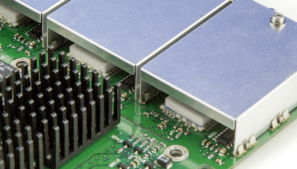
The Purpose of Board Level Shields Board level shields (BLS) are generally small metallic shielded boxes mounted directly to PC board ground return layers. There are three primary purposes of board level shields: Isolation of sensitive circuitry from other noisy circuits on the board Trapping the emissions from noisy circuits on a board from propagating to the outside … [Read more...]
Filter Installation Issues Pt. 2: The Synergy of Filtering and Shielding
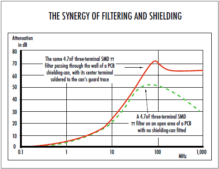
This article is part 2 of a three-part Filter Installation Issues series. Read Part 1: Input and Output Conductors here. Some mains filter manufacturers only design and specify their filters to provide attenuation over the frequency range of the conducted emissions tests (typically up to 30MHz for commercial and industrial products), to keep costs low. Unfortunately, if … [Read more...]
Use of Ferrite-Loaded Absorber to Reduce Wireless Self-Interference

Self-generated EMI from DC-DC converters, as well as digital and video processing, has long plagued designers of wireless and IoT devices, especially since physical sizes have trended smaller. The broadband harmonic content often extends up through 1.5 GHz, which includes most wireless protocols, cellular LTE and GPS/GNSS bands. One new mitigation technique I’ve been trying … [Read more...]
Designing and Selecting Filters: Maximizing Impedance Discontinuities

To design effective filters we must maximize impedance discontinuities, at the frequencies of concern for emissions and/or immunity. Capacitors are used in conjunction with the RF Reference Plane (see Figure 1) to create low impedances, applied in shunt, whilst resistors or inductors are used to create high impedances, applied in series. When the source and … [Read more...]
Designing and Selecting Filters: The Importance of RF Reference
The Importance of the RF Reference The RF Reference is the node on a circuit’s schematic that we define as our reference voltage when designing an RF circuit or measuring its performance. For the most cost-effective EMC, all circuits (digital, analogue, switch-mode, etc.) should now be designed using RF techniques. It is common practice to call the RF Reference ‘earth’ or … [Read more...]
- « Previous Page
- 1
- …
- 3
- 4
- 5
- 6
- 7
- …
- 27
- Next Page »