CONTENTS Introduction Basics e-Motors Battery Testing Summary Note: This article is an abridged version of the white paper “EMC and eMobility” published in 2024 by MVG, available at www.mvg-world.com. The full paper provides expanded technical detail and includes additional coverage of EV charging, which is only briefly referenced here for … [Read more...]
How to Build a Reliable TDR from S-Parameters to Reduce EMI Worries

When Two TDRs Don’t Agree As modern high-speed designs push into multi-gigabit and higher data rates, EMI and EMC engineers rely on multiple signal integrity (SI) metrics to evaluate interconnect performance. Among these, time-domain reflectometry (TDR) remains one of the most direct methods for identifying controlled impedance and … [Read more...]
EMC for Missiles

Introduction Missile platforms operate in some of the most extreme electromagnetic (EM) environments encountered by aerospace systems. The combination of high‑power radar, directed‑energy weapons, lightning, electromagnetic pulse (EMP), and electro‑static discharge (ESD) creates a complex threat landscape that can compromise functionality, safety, and survivability. Emphasis … [Read more...]
What’s New in MIL-STD-461H

The long-awaited revision to MIL-STD-461H was released on April 17, 2026. This revision formally supersedes MIL-STD-461G, issued on December 11, 2015. However, anyone involved in the MIL-STD-461 compliance arena understands that adoption through the procurement cycle will take time. There is no reason to discard those copies of revisions A through G anytime soon. Although I … [Read more...]
Can CubeSat ESD Testing with Sound Packaging Engineering Protocols Before Launch Ensure Successful Deployment? — Part 2

Read Part 1 of this CubeSats series here In 2016 and 2018, Bob Vermillion gave a series of groundbreaking presentations on “CubeSats Require ESD Handling Protocols for Launch & Space Survivability” to enthusiastic audiences of university graduate students, aerospace engineers, NASA civil servants and academic researchers at the NASA-Auburn Academy of Aerospace … [Read more...]
Evaluating Patch Antenna Printed Circuit Boards Utilizing RF Absorber and S11 Measurements

Introduction Patch antenna printed circuit boards (PCBs) are among the most common pieces of radio frequency (RF) hardware that exist in modern systems today. Wireless communications, automotive radar, and aerospace/defense systems rely heavily on these structures for transmitting and receiving electromagnetic energy. Since these structures are … [Read more...]
Affordable RF Test Setups for IoT Designers
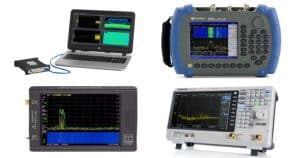
Introduction The number of connected devices keeps growing every year. Millions of devices exchange data wirelessly to make our lives easier. Wireless connectivity simplifies installation by removing cables, but it uses the electromagnetic spectrum, which is becoming more and more crowded. User demands have shifted connectivity from being a … [Read more...]
Your First EMC Bench Setup
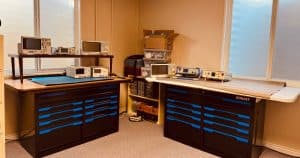
Complying with EMC regulations seems to be a challenge for many companies who manufacture electronic products. This usually comes to a head, if considered near the end of the development cycle. As an EMC consultant helping hundreds of clients, I've witnessed the resulting cost and schedule delays. Invariably, engineers will attempt to troubleshoot and … [Read more...]
Compliant by Design: Where Precision Meets Power Integrity in Aerospace Applications

Power integrity and regulatory compliance are the technical foundation of any mission-critical system. When they fail, the consequences can risk safety and costly assets, which is why design must produce predictable electrical behavior and a clear, testable path to certification. This brings focus to a key question for program managers: what is the … [Read more...]
5 Common PCB Design Mistakes for IoT Devices

IoT products are often seen as an entry-level product for many PCB designers, and they require application and protocol development. It’s no wonder so many engineers and design firms market themselves as IoT solutions providers. Developing an embedded application and throwing it on a microcontroller is all well and good, but you’ll never deploy thousands or … [Read more...]
- 1
- 2
- 3
- …
- 27
- Next Page »