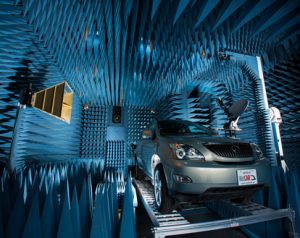
A new $15 million facility at the University of Waterloo, Canada is expected to contribute significantly to the development of next-generation wireless technology. Featuring four interconnected indoor laboratories, one outdoor lab and an advanced computational facility, the new 5,000 sq. ft. Centre for Intelligent Antenna and Radio Systems (CIARS) is said to offer the highest … [Read more...]
EMC Pioneer Ralph Showers Passes Away

Ralph M. Showers, Ph.D., of Havertown, Penn passed away at his home on Sunday, September 8, 2013. The IEEE EMC Society founder was 95. Born in Plainfield, N.J., he received his undergraduate and doctoral degrees from the University of Pennsylvania before becoming a professor at the Moore School of Electrical Engineering at the University of Pennsylvania. He was named emeritus … [Read more...]
Antenna Network Wirelessly Powers Devices

A new system provides wireless power to electronic and electrical devices using a series of antennas embedded underneath a surface, removing the need for electric cables. The Smart University Power Antenna (SUPA) Wireless technology uses a principle similar to that of induction cookers, according to researchers from the Fraunhofer Institute for Electronic Nano Systems (ENAS) … [Read more...]
Communication System Powers, Connects Battery-Less Devices
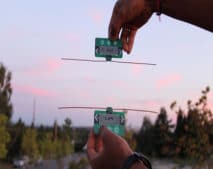
Engineers at the University of Washington have created a new communication system that takes advantage of wireless signals to power electronic devices without relying on batteries or wires. Known as ambient backscatter, the technique enables battery-less devices to exchange information with each other by repurposing existing Wi-Fi, mobile and television signals to act as both … [Read more...]
Astronauts Test Electromagnetic Propulsion Technology Aboard ISS
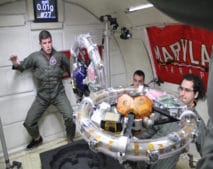
A new electromagnetic propulsion technology being tested on the International Space Station has the potential to extend the lifecycle of satellites and future spacecraft by providing a renewable power source. Created by researchers from the University of Maryland’s Space Power and Propulsion Laboratory (SPPL), the Resonant Inductive Near-field Generation System (RINGS) uses a … [Read more...]
Ford Looks to Outer Space for Reliable Connected Vehicle Technology

Ford is turning to outer space for inspiration in its latest project for connected vehicle technology. Researchers from the automotive giant will collaborate with St. Petersburg Polytechnic University in Russia on a three-year research project to observe the communication models of robots in space, with the aim of making connected vehicle networks more reliable. This project … [Read more...]
Researchers Design Acoustic-Based Data Transfer System for Smartphones

Researchers at Microsoft Research India have developed a new alternative acoustic-based data transfer system with capabilities similar to Near Field Communication (NFC) that requires no specialized wireless hardware. Derived from radio-frequency identification (RFID) technology, NFC enables low data rate, bidirectional communication between devices in close proximity in a … [Read more...]
Antique Poster Offers 1940s Look at Electromagnetic Radiation
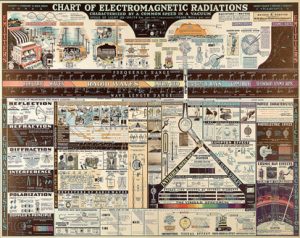
For those interested in scientific antiques, scientists at Lawrence Livermore National Laboratory (LLNL) recently released a detailed, super-high resolution retro electromagnetic radiation infographic online. Designed by W.M. Welch Scientific Company in 1944, the “Chart of Electromagnetic Radiations” depicts the entire electromagnetic spectrum and covers the properties, uses, … [Read more...]
Signal-Filtering Algorithms Tackle Smartphone Interference

New signal-filtering algorithms developed to reduce interference in smartphones could provide users with faster performance, longer battery life and fewer dropped calls. Created through a partnership between Kansas State University’s Electronics Design Laboratory and Lawrence, Kan.-based research company Avatekh Inc., the algorithms are intended to more efficiently combat … [Read more...]
U.S. Navy Tests Military Spectrum Sharing Potential

The U.S. Navy has taken a large step towards opening military frequencies for greater commercial use with a recent experiment that evaluated whether or not military and commercial devices can successfully share the same frequency without interference. In a recent test off the coast of Virginia's eastern shore, the Navy activated an AN/SPY1—a powerful naval radar system that … [Read more...]
- « Previous Page
- 1
- …
- 36
- 37
- 38
- 39
- 40
- …
- 42
- Next Page »