
Engineers at the U.S. Department of Energy’s Thomas Jefferson National Accelerator Facility have announced the development of new shielding materials to protect sensitive electronics from damage in high-radiation environments such as nuclear power plants, particle accelerators and medical applications. According to Jefferson engineers Paul Brindza and Bert Metzger, the three … [Read more...]
New Tools Combat Wireless Interference

A number of new tools created by MIT researchers to solve wireless network transmission interference problems are being recognized by the National Science Foundation. Dina Katabi, a professor in the department of electrical engineering and computer science at the Massachusetts Institute of Technology, and leader of MIT's networks research group has been working to address … [Read more...]
New Electrical Conductor Outperforms Graphene
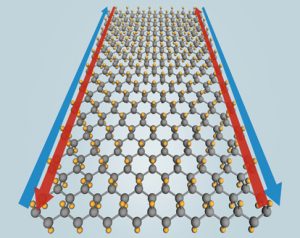
A new superconductor made from tin atoms is poised to overtake graphene by becoming the world’s first material to conduct electricity with 100 percent efficiency at the high operating temperatures used by computer chips. Known as “stanene,” the material was discovered by a team of theoretical physicists led by researchers from the U.S. Department of Energy’s (DOE) SLAC … [Read more...]
Stand-Alone Generator for Slow Damped Oscillatory Wave Testing

Teseq, a provider of equipment for EMC emission and immunity testing, has released its new stand-alone generator for slow damped oscillatory wave testing in single phase equipment up to 270 V and 16 A. Ideal for use by power stations, substations, electric meter manufacturers, relays and switch manufacturers as well as EMC testing laboratories that already use Teseq equipment, … [Read more...]
Electromagnetic Cloaking System Cancels Out Radio Waves

A new approach to invisibility cloaking from researchers at the University of Toronto, Canada has yielded an adaptable system capable of shielding objects of various sizes from radar detection. Developed by professor George Eleftheriades and Ph.D. student Michael Selvanayagam of The Edward S. Rogers Sr. Department of Electrical & Computer Engineering, the cloaking system … [Read more...]
Toyota Calls for More Testing to Prevent Connected Vehicle Interference

Toyota Motor Corp. is concerned that expanding Wi-Fi services could interfere with future auto safety technology and believes more testing is needed to ensure no such problems arise. Principal research manager John Kenney of the Toyota Info Technology Center in California told a U.S. House Energy and Commerce panel overseeing technology that the Federal Communications … [Read more...]
Robot Arm Aids in High Frequency Antenna Calibration Breakthrough
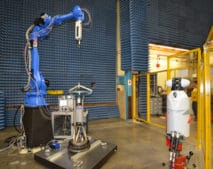
A new antenna testing method from researchers at the Physical Measurement Laboratory (PML) in Colorado could lead to greater accuracy in the characterization and calibration of antennas for use at 50 GHz to 500 GHz. Currently, “there are no international reference standards for antennas at these frequencies,” team member David Novotny of the Radio-Frequency Fields Group in … [Read more...]
RF Tuning Technology Could Increase Available Frequency Range in Wireless Devices

Scientists have announced a new research breakthrough they say could increase the range of wireless frequencies available in smartphones and other wireless devices while simultaneously reducing manufacturing costs. Researchers at Northeastern University, in cooperation with Semiconductor Research Corporation (SRC), found that the application of a certain amount of voltage to a … [Read more...]
Metamaterial Power Harvester Boasts Solar Cell Efficiency
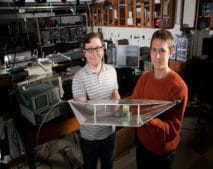
Researchers at Duke University’s Pratt School of Engineering in North Carolina have created a power-harvesting device that can be tuned to capture energy from various sources, including satellite, sound and Wi-Fi signals, and convert it to direct current voltage capable of charging small electronic devices. While the new device is not the first “energy-harvester” ever created, … [Read more...]
New Type of Filter May Help Bring Order to Crowded Radio Spectrum

Scientists from the Netherlands have developed a new type of filter based on micromechanical resonators they say is ideal for maintaining order amidst the expected future growth of frequency standards. According to researchers at the MESA+ Institute for Nanotechnology at the University of Twente, the new solution consists of two mechanical resonators that vibrate at an … [Read more...]
- « Previous Page
- 1
- …
- 34
- 35
- 36
- 37
- 38
- …
- 42
- Next Page »