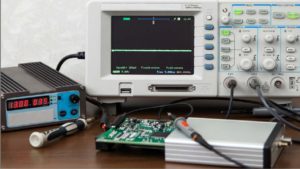
Introduction to EMC Radiated Emission Measurements There are two principal types of emission measurements in the world of electromagnetic compatibility, conducted emission and radiated emission. The conducted emission measurements are either a voltage-capacitive tap type of measurement (typically on a power line) or they are a current-clamp type of measurement (typically on a … [Read more...]
Resilience is Key to the Connected and Autonomous Revolution
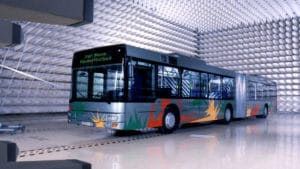
INTRODUCTION Connected and autonomous vehicles have long been hailed as the answer to safe transport. Around 1.25 million people die in road traffic accidents worldwide each year according to E&T– and driver error accounts for over 90 per cent of those deaths[1]. In theory, the removal of the driver as the lead decision maker for vehicle control should reduce this number, … [Read more...]
FCC’s New Equipment Authorization Rules – First Report and Order FCC 17-93

The FCC announced New Equipment Authorization Rules in the First Report and Order FCC 17-93 on July 13, 2017, and followed this on July 20 with a live webcast of a panel discussion featuring the FCC OET and lab division Chiefs providing details of the changes and answering manufacturer questions. Highlights of the First Report and Order This report and order streamlines … [Read more...]
Book Review: Foundations of Electromagnetic Compatibility (Adamczyk)
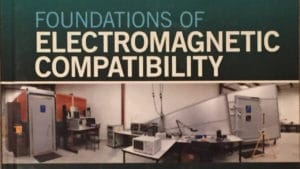
OK, this is not a book for the faint-hearted. Bogdan Adamczyk is a professor of engineering and the founder of the EMC Center at Grand Valley State University in Grand Rapids, MI. As such his recent book, Foundations of Electromagnetic Compatibility with Practical Applications (Wiley 2017, ISBN 978-1-119-12078-0) is crammed with derivations of basic electromagnetic … [Read more...]
Troubleshooting Radiated Immunity for Medical Products – Case Study

Introduction Companies making medical products have much more stringent requirements now that the new IEC 60601-1-2 (Edition 4) became effective June 17, 2017. One of the many changes included increased radiated immunity requirements in several specific wireless and communications bands (Table 1). Highlights of all the changes are included in Interference Technology’s free … [Read more...]
An Engineering Ethics Question for Today

I’ve been presenting a seminar on engineering ethics to students in the Electrical Engineering Department at Washington State University for a number of years. I’ve started off with a video of the Challenger explosion and the questions leading up to it as expressed by Roger Boisjoly, a Morton Thiokol engineer. Roger Boisjoly had studied data showing that the field joint … [Read more...]
Joining the New Defense Acquisition University (DAU) Spectrum & EM Compliance Community of Practice (CoP)
The Defense Spectrum Office has sponsored for many years, the Spectrum and EM Compliance Special Interest Area on the DAU’s Acquisition Community Connection (ACC) portal. This Community of Practice (CoP) serves as a platform to connect Spectrum and E3 Compliance practitioners from across multiple career fields, offering them a chance to talk, share, and acquire knowledge about … [Read more...]
Selecting the Proper EMI Filter Circuit For Military and Defense Applications

Introduction Insertion loss, the term used to express a filter’s ability to reduce or attenuate unwanted signals, has traditionally been measured in a 50 ohm source and 50 ohm load impedance condition, as standardized in MIL-STD-220. In this matched 50 ohm impedance condition, various types of filter circuit configurations, single capacitor, “L’s”, “PI’s”, and “T’s”, will … [Read more...]
Simulating EM Shielding for Aeronautical Applications
The airframe of an aircraft can provide some measure of shielding against high-intensity radiated fields (HIRF), but this is compromised by doors, windows, seams, access panels and components interfaced to the airframe such as antennas used for communication and navigation. Composite materials are increasingly used in aeronautical applications due to their relatively light … [Read more...]
Choosing and Using Silicon Protection Devices
Introduction Correctly choosing an external (off chip) Transient Voltage Suppressor (TVS) is not as simple as it once was. Integrated Circuit (IC) feature size is shrinking (Figure 1) and more and more inputs are being exposed to the outside world. Portable consumer devices are everywhere and have more functions in smaller and smaller sizes, necessitating smaller and smaller … [Read more...]
- « Previous Page
- 1
- …
- 21
- 22
- 23
- 24
- 25
- …
- 74
- Next Page »