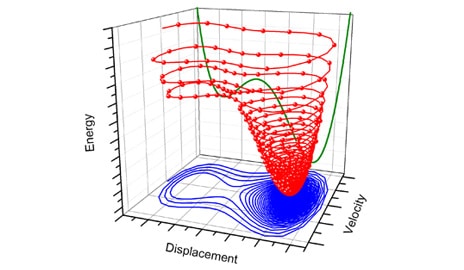
New research by engineers at the Yale School of Engineering & Applied Science demonstrates that nanomechanical resonators can operate at much higher amplitudes than previously thought. The results represent an advance in optomechanics, in which the force of light is used to control mechanical devices. The findings could have implications for future communications and sensing technologies. Achieving high-amplitudes in traditional nanoscale mechanical systems has proven difficult because reducing a resonator’s dimensions generally limits how much the resonator can move. Tang’s team shows a way of overcoming the performance limitations of conventional systems.The research team also demonstrates that a tiny silicon structure within an optomechanical system can effectively store information without the aid of steady power supply, thus serving as a mechanical memory device.Among other benefits, optomechancial memory devices can withstand harsher environments than electronic or magnetic memory devices, without losing data. Future technologies containing similar high-amplitude optomechanical resonators might be less sensitive to environmental conditions, such as variations in temperature and radiation. At the same time, high-amplitude resonators might enable more accurate and robust measuring devices.Learn more from Yale.
Researchers Find Nanomechanical Resonators Can Operate at Higher Amplitudes