Introduction to RF Power Amplifier You need an RF power amplifier. You have measured the power of your signal and it is not enough. You may even have decided on a power level in Watts that you think will meet your needs. Are you ready to shop for an amplifier of that wattage? With so many variations in price, size, and efficiency for amplifiers that are all rated at the same … [Read more...]
Amplifiers
Plugging into a Power Source 93 Million Miles Away
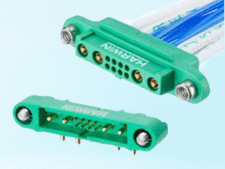
Harwin Gecko-MT 1.25mm pitch Mixed Layout Connectors Connect with confidence with Harwin’s Gecko-MT range; the smallest and lightest mixed-layout connector available for high-reliability applications. The Gecko-MT range combines the 1.25mm pitch Gecko signal connector system with mixed technology layouts, which adds 10A power contacts to the range, providing additional … [Read more...]
An Isotropic Probe for Radiated Susceptibility Measurements from 10kHz to 18GHz and 5V/m to 220V/m
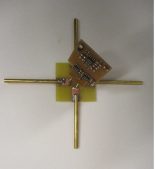
Abstract: Isotropic probes are available for radiated susceptibility test level measurements from 100kHz to 6GHz, 2MHz to 18GHz, 2MHz to 40GHz and 2MHz to 60GHz. For MIL-STD-461 and DO-160 testing a frequency range of 10kHz to 18GHz would be better and a possible solution is presented here. Introduction The probe described in this paper has three separate sections, … [Read more...]
EMC Confidence Checking

I was recently working with a manufacturer of stand-alone ticket machines, who had big problems with Ethernet-related emissions. Long story short – it was the Ethernet hub they had incorporated in their machine. They had assumed that all CE-marked Ethernet hubs would be equally good for EMC, and they had several different types lying around their design department. We tested … [Read more...]
Mains Harmonic Current Emissions are Always Bad – It is Risky to Rely on the Limits or Exclusions in the Standards

Many (perhaps all) of EMC standards that are listed under the EMC Directive, that set limits for mains harmonic emissions, have exclusions (‘let-outs’) for certain types of equipment, especially: (these examples are from IEC/EN 61000-3-2 Ed.5:2018) Lighting equipment with a rated power of less than but not equal to 5W Equipment with a rated power of 75W or less, e.g. … [Read more...]
Key Points to Remember While Choosing PCB Assembly Company

Once you have designed a PCB and have completed everything that needs to be done before the assembly process, you would require a PCB assembly company to assemble your PCB without any problems. After all, you've been working considerably hard to assemble the layout and the design of the PCB. You would want to be convinced that your PCB gets well-assembled. To ensure that the … [Read more...]
Review: EMI Devices Harmonic Comb Generator
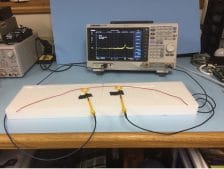
Harmonic comb generators are handy tools for validating open area test sites or semi-anechoic chambers and I've written extensively on how to use these for various other applications (see References). Harmonic comb generators produce a range of narrow band harmonics that are typically very stable in amplitude and frequency. One of the major uses is to position one in place … [Read more...]
Risks Associated with EMC and EMI – Don’t get Confused!
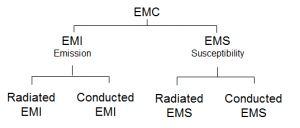
There are many kinds of risk For example: the risk of being late for an appointment; the risk of buying a lottery ticket but not winning a prize; the risk of designing and manufacturing a new product that might not sell well enough, etc. The above are examples of non-safety-related risks, but safety-related risks also exist. EMC1 Risk Management (or, the Risk Management … [Read more...]
A Simple Method for Estimating Radiated Emissions – Part 2
I recently published this blog, detailing a simple proven method for estimating the radiated E field with specified test setup. As a result, I received the following feedback... 'This model is wrong for equipment tested over a ground plane as described. The complex correct transmission line model (less the ground plane) is given by Balanis, and a simpler but accurate … [Read more...]
A Simple Method for Estimating Radiated Emissions

A simple method for estimating radiated emissions I recently received the following question: How to calculate the radiated E field with following test conditions with an antenna placed 1 meter away from the test setup?: A commercial equipment under test with metal housing Equipment placed on the grounded metallic table/plane LISN installed (and also placed … [Read more...]
- « Previous Page
- 1
- 2
- 3
- 4
- …
- 49
- Next Page »