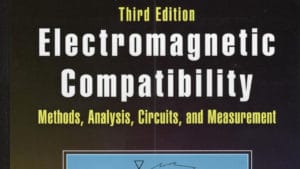
Electromagnetic Compatibility - Methods, Analysis, Circuits, and Measurement, David Weston, CRC Press, 2017 (3rd edition) While I've reviewed many books on EMC, this one by David A. Weston, is the most complete in coverage yet. The 1157-page book covers not only basic and advanced theory of EMC, but includes product design, commercial and military measurement techniques, and … [Read more...]
2017 DoD E3 Program Review – After Action Report

By Brian Farmer on behalf of the DSO E3 Program Review Team After a five-year hiatus, the 2017 Department of Defense (DoD) Electromagnetic Environmental Effects (E3) Program Review was held April 3 - 7 at Lackland Air Force Base, San Antonio, TX. Over 60 technical presentations were delivered throughout the week, three working groups were convened, 12 exhibitors displayed … [Read more...]
The Importance of Layout in ESD Suppressing Diodes
ESD protection of sensitive electronics via transient voltage suppression (TVS) diodes is becoming a common circuit technique across industries. Signal lines in a circuit that are accessible to humans by touch (such as USB, HDMI, etc.) require ESD protection on all sensitive signal lines that are input to some IC’s. Placement of the ESD protection diodes on the circuit board … [Read more...]
Measuring Common Mode Versus Differential Mode Conducted Emissions
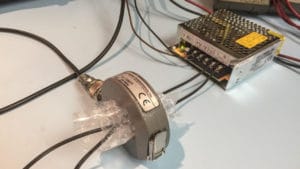
When faced with excessive conducted emissions from switching power supplies, one of the first things to investigate and to determine the adequacy of is the power line filter. Line-powered switching supplies generally have both common mode and differential mode sections of the filter as shown in the generalized schematic in Figure 1. When using a line impedance … [Read more...]
EMC LIVE 2017! The Time is Now – FREE Registration is Open!

Join the fastest growing online EMC event of the year. EMC Live teaches the latest in practical solutions to electromagnetic interference (EMI) challenges - all for FREE, and all LIVE. Learn directly from industry professionals during 3 days of technical webinar presentations, product demonstrations, and an abundance of resources from whitepapers to application … [Read more...]
ESD Effects of Digital ICs

One issue I see fairly often with unshielded consumer or commercial products is CPU resets during periods of immunity testing, such as during electrostatic discharge (ESD) testing. Untreated, this can lead to field failures and associated customer satisfaction issues. The remedy is usually quite simple and IC manufacturers even mention the solution, but it’s usually buried … [Read more...]
Energy Harvesting is Not Fiction Anymore

“About what we did dream today, are the ideas from tomorrow. The tomorrow ideas are the products from the days after tomorrow.” Our environment is changing and everything is becoming “electronified”. Our glasses, our hand gloves, shirts, shoes etc., can be connected already today with our smartphones and can send commands to the machinery surrounding us. We want this comfort, … [Read more...]
Narrowband Versus Broadband Harmonic Signals

Radiated and conducted emissions measurements are often comprised of both narrowband and broadband sources. So what differentiates “narrowband” and “broadband” signals? Narrowband Versus Broadband Signals The definition of whether a signal is narrowband or broadband as measured using a spectrum analyzer, depends entirely on the receiver bandwidth (resolution bandwidth, or … [Read more...]
Review of IEC 60601-1-2: 2014 (4th Edition)
Introduction IEC 60601-1-2:2014 Edition 4 was published February 2014 and replaces IEC 60601-1-2 Edition 3 published on 2007. It pertains to EMC for medical electrical equipment and medical electrical systems. The European version (EN60601-1-2:2015) is identical to its IEC counterpart with exception of references to the EN versions of the 61000-4-x series and the addition of … [Read more...]
Troubleshooting EFT
EFT Phenomenon Recently I tested a medical device for EFT susceptibility. The requirement is that the medical device must be immune to EFT bursts generated per IEC 61000-4-4. Per this standard EFT bursts are applied in four steps. For level 4, steps 1 and 2 are +/-2kV at 5kHz, and steps 3 and 4 are +/-2kV at 100kHz. For each step, these bursts are applied at 300ms interval for … [Read more...]
- « Previous Page
- 1
- …
- 12
- 13
- 14
- 15
- 16
- 17
- Next Page »