
Every day, more and more objects are getting connected, building local networks and connecting to the Internet.
While the development of new connected devices has never been as accessible as it is today, there are still many questions around how to legally bring Internet of Things (IoT) devices to the market.
This article aims to clarify the process of placing IoT devices in the European market, the European Union’s Radio Equipment Directive (RED).
IoT AND EMC: WHY DO IoT DEVICES NEED EMC?
An IoT device is a physical object embedded with electronics that:
- Collects data or interacts with the physical world
- Has connectivity to communicate with other devices
- Has processing capability to handle or transmit data
From the EMC perspective, they are systems that:
- Have some kind of power supply: AC, DC or battery
- Have a communication method (wired or wireless)
- Can perform one or more operations
In a world where we have increasingly connected devices, we should make space for all of them, so they can co-exist without interfering with each other.
IoT devices need to be designed so as not to interfere with their own system (self-interference) and with other systems.
The article Cost-Effectively Ensure Electromagnetic Compatibility in the Age of IoT describes in detail the challenges of designing modern IoT devices without skyrocketing the costs.
We can conclude the following:
- Every electronic device, including IoT devices, must go through EMC testing
- The increasing demand for connectivity (WiFi, Bluetooth, Zigbee) makes life easy for users but hard for designers
- The complexity-to-price ratio is becoming unsustainable, forcing manufacturers to find creative ways to lower development and test costs
RADIO EQUIPMENT DIRECTIVE (RED)
The RED is the European Union (EU) law that establishes the regulatory framework for placing radio equipment within the European Economic Area (EEA).
With some application specific exceptions, the directive covers electrical and electronic products intended to transmit or receive radio waves for radiocommunication or radiolocation, including accessories (antennas) up to 3000 GHz (3 THz).
Essential Requirements
The term “essential requirements” shows up in many areas of the European directives. The essential requirements are the minimum requirements that a manufacturer needs to comply with.
These requirements fall within four categories:
- Safety: Protection of health and safety of humans, domestic animals and livestock
- Electromagnetic Compatibility (EMC): Appropriate level of EMC
- Radio: Effective and efficient use of radio frequencies
- Cybersecurity: Network protection, data privacy, and fraud prevention
Every product needs to fulfill the essential requirements. In this article, we will focus only on the EMC aspects of the RED directive.
Harmonized Standards and Product-Specific Standards
The Standard EN 301 489 is a multi-part harmonized standard for radio equipment.
The EN 301 489-1 defines general EMC requirements common to all radio equipment. It must be used together with product-specific parts (mobile communications, TV broadcasting, satellite services, etc.).
For the most common IoT applications, the relevant product-specific parts are:
- EN 301 489-17: broadband and wideband data transmission systems, including Wi-Fi, Bluetooth, and other Industrial Scientific Medical (ISM) radios
- EN 301 489-52: cellular communications terminals and ancillary equipment
- EN 301 489-3: short-range devices (SRD) operating between 9 kHz and 246 GHz
It is important to use the part that corresponds to the technical radio aspects of the system. The different parts cover EMC requirements (limits) as well as test set-ups.
Who needs to respect the RED?
Any economic operator responsible for placing radio equipment on the EU market.
They are not only manufacturers — they can also be authorized representatives, importers, and distributors.
Let’s deep dive into each of them, considering an electronic product:
- Manufacturer: Designs or brands the product
- Importer: Places it on the EU market
- Authorized representative: Acts on behalf of the manufacturer
- Distributor: Makes the product available to end users
Each role has different responsibilities regarding the RED compliance.
The key point is that no matter which role an operator has, they will always have responsibilities that are not transferrable.
WHY EMC MATTERS IN IOT DEVICE DESIGN
Electromagnetic compatibility matters to any electronic device. They need to coexist with other existing and future devices.
The low barrier to entry to the development of new connected devices has provoked an increasing population of devices where in the past there was only radio silence.
Today, it is easy to build and install a new connected device which competes for the same real-state spectrum as your WiFi router, Bluetooth headphones or sub-GHz garage remote controller.
If we want to avoid the chaos in our neighborhood, our office, or any other public space, we need to ensure that the emissions are low and that they can withstand a sufficient amount of surrounding noise.
EMC has two implications: regulation and performance. A common misunderstanding is that EMC is just a matter of compliance — another box to tick at the end of the product lifecycle.
This misconception leads to hundreds of devices failing EMC tests the first time they reach the laboratory every year. On top of that, the performance of an electronic device is not disconnected from their EMC robustness.
Since the volume of devices is decreasing and the complexity is increasing, the stakes for performance are higher than ever.
Impact on Regulations
The legal responsibility cannot be ignored. The concept of self-certification is often misleading, giving the impression that respecting the radio and EMC regulations is not compulsory, or that nobody will actually check.
Compliance with the RED directive is done by market surveillance, an enforcement mechanism that makes sure radio equipment already placed on the EU market continues to meet the essential requirements throughout its lifecycle.
Each EU member has market surveillance authorities that monitor the local market. They are authorized to conduct random inspections, test products in accredited laboratories, and request technical files.
Therefore, even though it is possible to place a product in the market and start selling it, it remains necessary to guarantee that the device complies with the regulations during its entire lifecycle.
Impact on Device Performance
IoT devices rely on radio communication that must perform reliably in a wide variety of environments.
To achieve this, the radio link parameters must be robust enough to guarantee consistent communication. The amount of different parameters that designers need to consider can be overwhelming.
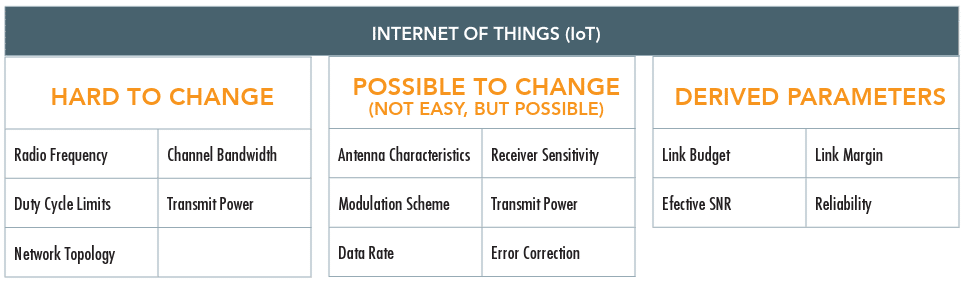
We can classify these parameters in three categories:
- Very difficult to change: They are dictated by functional requirements or regulations and may be impossible to change. Examples include frequency and transmit power.
- Possible to change: Designers can adjust these parameters, though changes will affect the radio link. Examples include the modulation scheme and data rate.
- Derived parameters: These result from the choices made in the first two categories. An example is the link budget.
All these lists of parameters should be carefully taken into account when designing and testing an IoT device. They are also impacted in real environmental conditions, when interference is present.
This means that EMC problems can modify the target value of each of them, impacting the quality of an IoT product.
This is why EMC becomes challenging in IoT devices; there are a lot of balls to juggle.
Enjoying this article?
Subscribe to Interference Technology for expert coverage of EMI, EMC, and signal integrity challenges—plus immediate access to new digital magazine issues.
Subscribe here →
Navigating the RED Directive
Facing the Radio Equipment Directive (RED, 2014/53/EU) for the first time can be overwhelming. An IoT device with wireless communications needs to meet the essential requirements for:
- Efficient radio spectrum use
- Electromagnetic compatibility
- Health and safety (human exposure to RF)
- Cybersecurity and fraud protection (since 2025)
While every product has its particulars, so the specific steps could vary, the high-level process to go through the RED for an electronics product is:
1. Define the product scope: confirm that the RED directive applies.
- Check if other directives apply
- Clarify radio frequency bands
- Define intended markets
2. Identify essential requirements
-
- Health and safety
- EMC
- Radio Spectrum
- Additional requirements
3. Incorporate design techniques for compliance:
-
- Optimal PCB stackup
- Grounding
- Filtering
- Shielding
4. Perform pre-compliance tests
-
- Ensure the integration of modules
- In-house EMC verifications with near-field probes or current probes
5. Perform compliance tests
-
- Internal testing or with an accredited test house
6. Prepare a technical file (must be kept for ten years)
-
- Product description & intended use
- Risk assessment
- Block diagrams & schematics
- Antenna specifications
- Test reports
- Photos
- Software version information
- Applied standards list
- Any DoC (Declaration of Conformity) from modules
- Assembly and user manuals
7. Draft the EU Declaration of Conformity (DoC)
-
- State applied directives
- List harmonized standards used
- Manufacturer (or the applicable economic operator) details
- Signature of the authorized person
8. CE marking
-
- Affix the CE mark visibly on the device
- If a Notified Body was involved, add their 4-digit NB number next to CE
9. Notified Body (If applicable)
-
- EU-type examination certificate
NOTIFIED BODIES (NB)
Notified Bodies (NB) are independent organizations designated by the EU member states to assess whether products comply with specific directives, like the EMC or the RED, before products are placed on the market.
When harmonized standards are not applicable or they are partially used, a Notified Body needs to be involved.
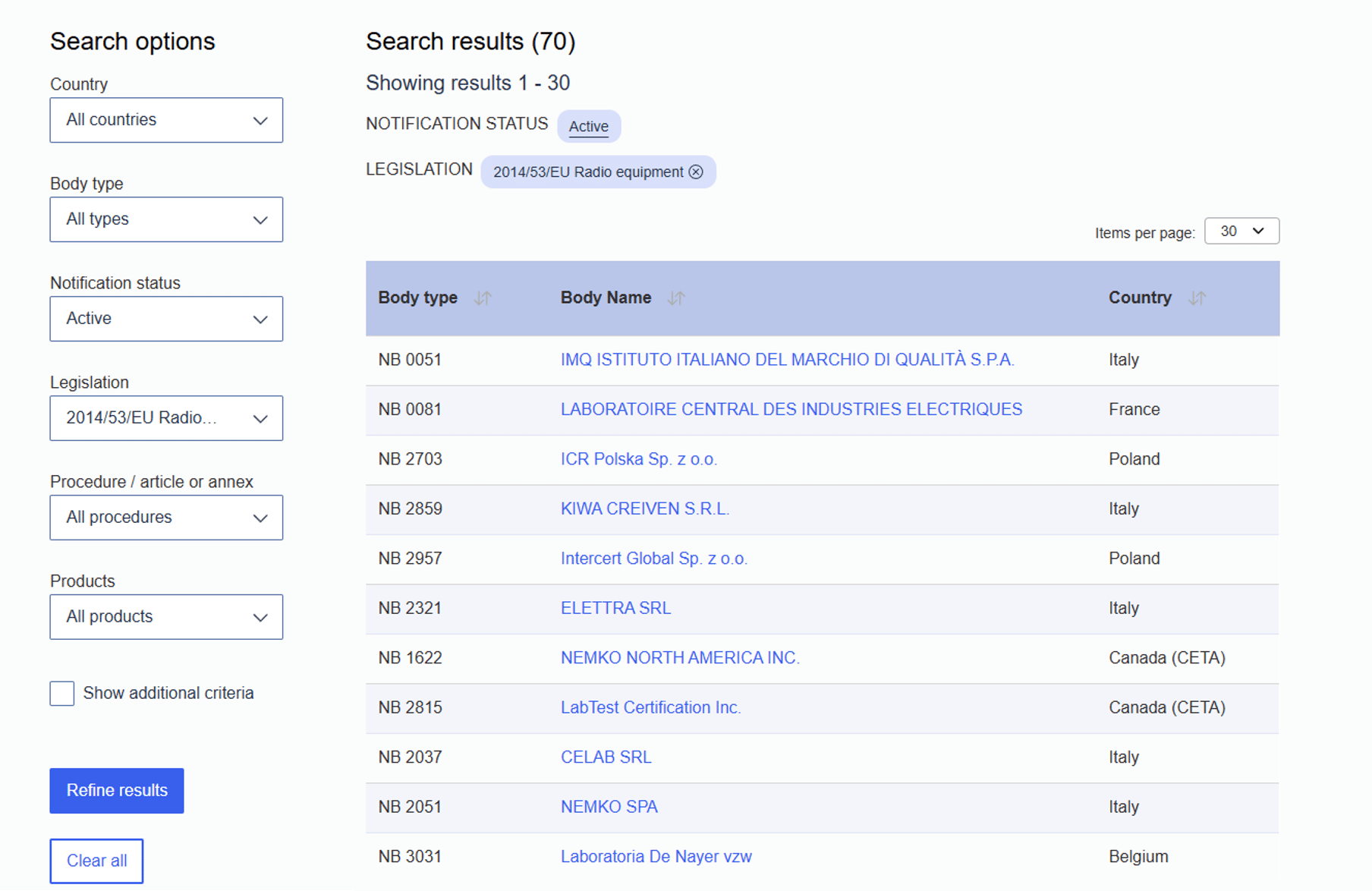
The list of Notified Bodies is available in the New Approach Notified and Designated Organisations (NANDO) database.
Figure 1 shows a glimpse of the Notified Bodies for the RED directive at the time of this article’s publication.
THE PROCESS DOES NOT NEED TO BE PAINFUL
While it is common to hear stories about complicated certification processes and horror stories, the truth is that it is possible to bring a product to the market without too many surprises.
The key to achieving this is good planning and a systematic process. To keep development and test costs low, it is recommended to start thinking about certifications in the early stages.
Most times, manufacturers push the resources for certification to the end of the project because of one or more of these reasons:
- Lack of knowledge on the process: There is not a single road to compliance and sometimes the in-formation they receive is contradictory, so they decide to focus on the areas they feel more confident working on.
- Lack of resources: They do not have specialists that can share insights at the beginning of the project, and since there is not a clear need for support at early stages, they do not look for them.
- Resistance to change: They have been developing and launching new products for years or even decades. People get used to doing things in the way they have always done it, so they do not find a lot of reasons to change the process.
Hopefully, this article brings clarity on the process and you are more convinced that, with enough preparation, certification processes become predictable.