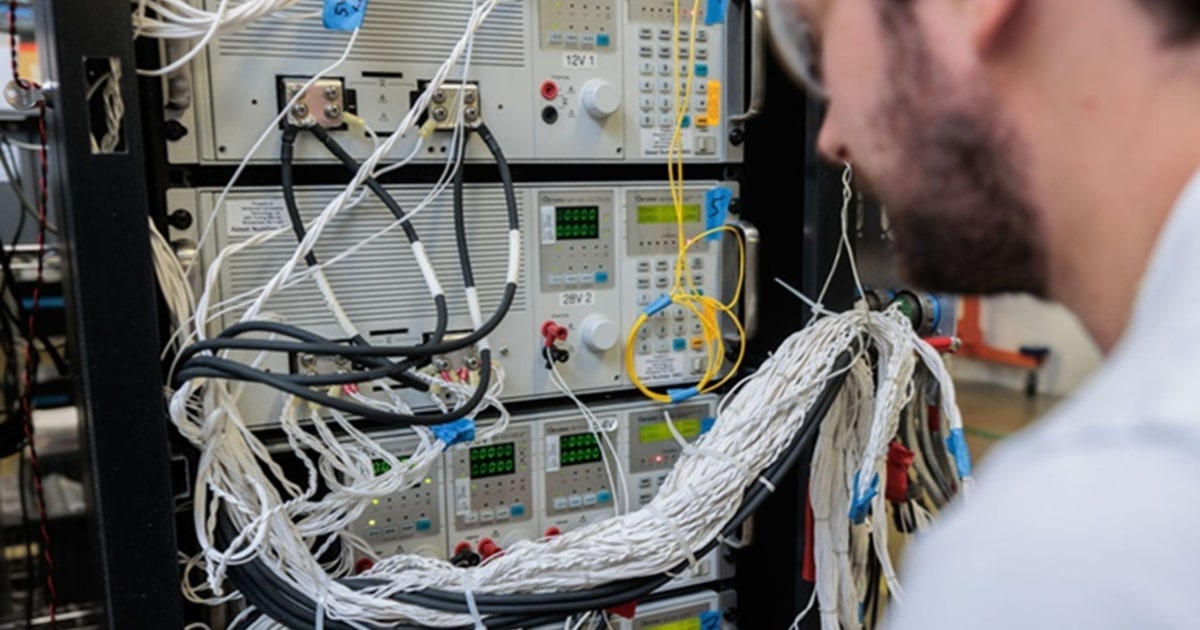
Power integrity and regulatory compliance are the technical foundation of any mission-critical system.
When they fail, the consequences can risk safety and costly assets, which is why design must produce predictable electrical behavior and a clear, testable path to certification.
This brings focus to a key question for program managers: what is the best power supply for harsh aerospace environments?
This article provides a roadmap for answering that question, guiding program managers and engineers through the critical military standards, design considerations, and acquisition strategies that ensure mission-critical systems are powerful and compliant.
By breaking down complex requirements, you will be better equipped to make informed decisions that reduce risk and shorten the path to certification.
Why Power Integrity is a Strategic Imperative
Achieving power integrity represents the ability to achieve stable, low-impedance power to crucial electronic components under any operating condition.
This is critical for aerospace and defense applications, where mission success often hinges on microsecond-level performance margins, and field failures can be extremely costly to remedy or even diagnose.
When a voltage delivery becomes unstable or fails to respond adequately to current demands, the consequences can grow far beyond simple shutdowns.
Silicon devices can age prematurely due to voltage stress, subtle erosions in performance can go undetected during ground testing but manifest during demanding field operations, and intermittent faults can resist traditional debugging by appearing to be software faults.
These failure modes carry risk and have occurred frequently in programs.
For example, NASA’s Armstrong Flight Research Center recorded integration phase problems where EMI caused a loss of battery and system data, forcing targeted mitigation and re-test activities.
Likewise, research on unmanned aerial systems and small platforms shows that strong EMI environments can directly cause malfunctions and impaired functionality of flight systems, underscoring EMI as a major concern.
Power-related failures can propagate. For instance, a marginal regulator or poorly filtered rail can create transient faults that cascade through digital control loops, confuse sensors, and trigger false safeties.
Any of these issues can abort a mission or require costly recovery.
Fixing those problems late in development is orders of magnitude more expensive than designing to mission profiles in the beginning. It drives schedule risk and larger sustainment costs.
Powertrain requirements and EMI or EMC protocols shorten certification paths and give program managers the numbers to readiness.
In short, prioritizing power integrity design protects mission assurance and transforms a risk into a more manageable engineering outcome.
Key Military Power Standards
Standards define the electrical, environmental, and electromagnetic rules that shape every design decision for military power systems.
Before selecting topologies, filters, or thermal strategies, teams must translate mission profiles into the applicable standard requirements so designs are certifiable and repeatable in the field.
MIL-STD-704: Taming the Source
MIL-STD-704 defines the electrical interface between aircraft power systems and airborne equipment, including voltage levels, frequency and waveform characteristics, acceptable abnormal conditions, and the limits that utilization equipment must tolerate.
This standard intends to ensure compatibility, so equipment connected to an aircraft’s power bus will survive and operate across the full range of real-world aircraft power behaviors.
In other words, MIL-STD-704 covers steady-state and transient phenomena, and it pairs with the MIL-HDBK-704 series, which outlines the test methods and procedures to demonstrate compliance for different power groups.
Test guidance often specifies measurements close to the equipment input, so designers must consider cable, connector, and local filtering effects.
Compliance with MIL-STD-704 means designing input stages to withstand significant variations in input power and fast transients.
A strong engineering practice must always align directly with the requirements of MIL-STD-704 compliance.
Specialist engineering firms design rugged input stages, validate transient susceptibility with measured test rings, and produce application notes and program-specific data that demonstrate performance against aircraft power profiles.

By pairing mission-tailored design choices with measured verification, it reduces integration risk, shortens test cycles, and helps move hardware from prototype to flight-qualified more efficiently.
MIL-STD-461: Mastering the Spectrum
MIL-STD-461 details the Department of Defense’s requirements for controlling EMI emissions. It defines the limits and test methods equipment must meet to operate smoothly on military platforms.
Compliance with this standard has a multitude of stipulations that must be achieved.
For example, devices must not emit levels that interfere with neighboring systems, and they must be able to tolerate external electromagnetic stressors without functional degradation.
Shielded enclosures, which prevent external environment signals from contaminating emission measurements, are also required for all tests within this standard.
The primary requirements are also in conjunction with the applicable detailed emission and susceptibility requirements and associated test procedures specified in the document, and dependent upon the equipment being tested and its application.
The standard is most relevant for electrical interconnections that are discrete wiring harnesses between enclosures, electrical power input derived from prime power sources, and electronic enclosures that are no larger than an equipment rack.
In practice, people apply MIL-STD-461 through a list of conducted and radiated test procedures that cover emissions and immunity across frequency bands and coupling modes.
Commonly invoked tests for platform electronics include CE102, CS115 and RS103. Each drives concrete design choices for filtering, cable routing, grounding, and enclosure shielding.

Meeting MIL-STD-461, therefore, requires an integrated engineering approach.
The capability for advanced input and output filtering, disciplined grounding and bonding, strategic enclosure and aperture shielding, and cable harness treatments is paramount. Leveraging solutions like these means teams can directly address the standards’ test regimes.
The production of test plans, pre-test data, and program-specific application notes also ensures design choices are accompanied by measurable evidence during lab and integration testing, reducing surprises during formal qualification.
The Challenge of Co-Compliance
Co-compliance occurs when EMC and power-source requirements intersect, and it is where most late-stage surprises arise.
An EMI filter that cleans conducted or radiated emissions can also change the input impedance, add series inductance or capacitance, and alter a unit’s ability to ride through a transient or supply dropout defined by aircraft power standards.
Put simply, a filter that helps pass an emissions test can make the same unit fail a transient requirement, depending on the load impedance and switching speed.
Recognizing those interactions early is a core systems engineering responsibility rather than a bench-level tuning exercise.
Technically, the trade space centers on impedance, energy storage, and coupling paths.
High input capacitance and tight common-mode filtering reduce radiated and conducted emissions, but increase inrush current, which can limit the effective holdup time available during a source sag.
Series chokes and long cable runs improve immunity when correctly bonded, but they introduce resonances and voltage droop that require control.
Because these effects are frequency-dependent and state-dependent, resolving them requires combined time and frequency-domain analysis, pre-compliance testing, and iteration between filter topology and derating rules.
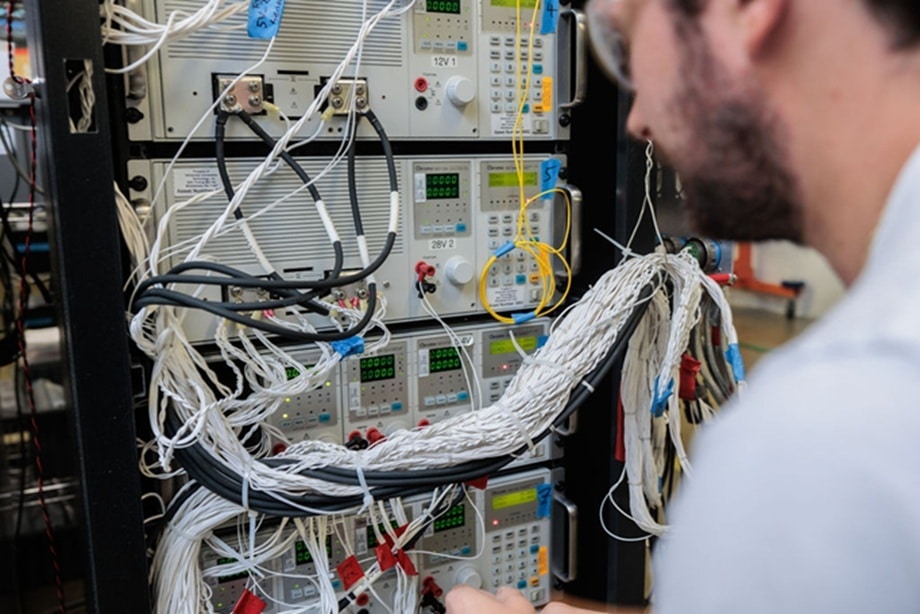
Pairing circuit and EMC simulation with mission-representative transient rigs helps to quantify how proposed changes to a filter, harness, or enclosure will affect emissions and source tolerance performance.
This style of workflow lets teams converge on solutions that meet MIL-STD-461 emissions and immunity criteria without compromising MIL-STD-704 transient and holdup requirements.
That means fewer integration rework cycles and a defensible, data-backed case to present to certification authorities, showing that professionals engineered the powertrain for the mission.
Enjoying this article?
Subscribe to Interference Technology for expert coverage of EMI, EMC, and signal integrity challenges—plus immediate access to new digital magazine issues.
Subscribe here →
Engineering for Real-World Military Environments
Designing for kinetic forces begins with an acceptance that fielded hardware will see shocks, vibration, and repeated mechanical loading that far exceed bench conditions.
Engineers must characterize likely excitations, identify resonant modes, and harden the mechanical path from chassis to printed circuit board (PCB).
Secure mounting, connector retention features, and targeted damping all reduce the risk of intermittent connections or cracked components.
Survivability also depends on material choices and assembly methods.
Potting or vibration-rated fasteners can protect delicate power stages, while judiciously placed isolation mounts prevent structure-borne energy from coupling into sensitive circuitry.
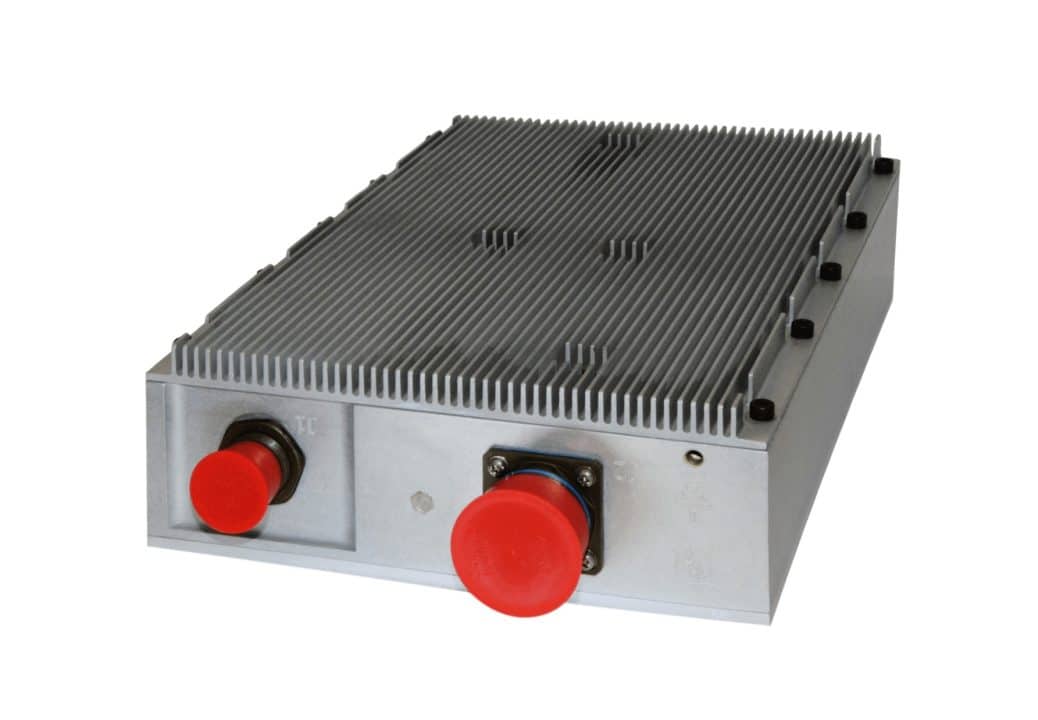
Thermal management is equally decisive.
Heat moves by conduction, convection, and radiation, and high-power, sealed enclosures demand approaches that go beyond open-air heatsinking.
Base-plate cooling, heat pipes, and liquid cold plates provide predictable conduction paths.
Thermal interface materials and controlled derating preserve component life.
Meanwhile, computational fluid dynamics (CFD) modeling helps validate airflow and temperature gradients before building the hardware.
Effective thermal design is about transient heating, hot spot control during high-duty bursts, and ensuring adequate margin across the full operational envelope.

A strong engineering practice ties these disciplines together with mission-focused verification. A professional team uses modal and vibration analysis, along with thermal mechanical testing and CFD-guided prototypes, to prove that a proposed powertrain will survive in the real world.
By specifying mount strategies, thermal interfaces, and derating rules and validating those choices, it reduces integration surprises and produces power subsystems.
How to Navigate the Power Supply Acquisition Process
Acquiring a military-grade power supply is a structured engineering and program management exercise. Precise requirements, disciplined supplier evaluation, and an evidence-driven verification plan are the levers that separate on-time, certifiable deliveries from late redesigns and cost growth.
1. Holistically Define Your Requirements
Before soliciting vendors, lock down the problem from both sides — the source and the load. A useful specification captures worst-case simultaneous loads, inrush currents, duty cycles, transient profiles, expected EMC and EMI environments, thermal envelopes, and more.
Implement mission scenarios as a first-class requirement, so the power train is designed and tested against the realities it will face.
Turn that knowledge into an actionable “source and load” document that drives procurement and verification.
Include clear acceptance criteria and a staged verification plan. Also, run a design review and a pre-compliance test early to ensure a smooth pass.
It is far less expensive to iterate on requirements and topology before building complete prototypes than to chase fixes during integration.
2. Survey the Commercial Off-the-Shelf (COTS) Landscape
With a solid source and load document in hand, the most efficient first step is to map COTS components. Shortlist suppliers whose baseline offerings match your mission envelope, then evaluate the evidence behind their claims.
Request preexisting reports, thermal maps, holdup calculations, and example integration notes. Then, pay attention to life cycle factors, lead times, and the supplier’s ability to deliver application-specific support when a standard COTS part comes close to meeting your needs.
Where a true off-the-shelf unit is suitable, it can save on both schedule and cost. Where it falls short, a COTS-plus or small modification path often provides a lower-risk route than a ground-up custom design.
Build evaluation gates into procurement through a documented prequalification test, a supplier capability review, and a small sample run validated on a mission-representative rig before awarding volume purchase.
3. Analyze the Gaps for a Modified Off-the-Shelf (MOTS) Opportunity
When a COTS product covers most of your requirements but falls short on one or two mission-critical points, a MOTS approach is often the lowest-risk path to a certifiable solution.
Industry analysis indicates that MOTS is the second-largest portion of the embedded systems market, making a close COTS fit a practical starting point a common, evidence-based practice.
The workflow is simple but disciplined. Document the exact functional gap, present it to shortlisted vendors, and ask for a scoped modification proposal that includes engineering effort, test evidence, schedule impact, and lifecycle support.
Procurement teams should leverage MOTS for planned engineering. Require predefined change orders, prequalification runs, and documented test plans, so the modification stays bounded and auditable.
4. Justify the Investment for a Full Custom Design
If COTS and MOTS cannot meet a mission requirement, a full custom design is justified, but only with a business case that treats the work as engineering.
You should choose a custom power solution because it materially reduces operational risk or unlocks the required capability that no commercially available part can deliver without unacceptable compromise.
That business case needs traceability. Tie each custom feature to a mission requirement, show the alternative fails those requirements, and quantify the operational cost of that failure.
A defensible justification also accounts for total lifecycle cost, schedule risk, and technical risk. Include realistic non-recurring engineering estimates, test cycles, certification time, and obsolescence or long-term support plans.
Compare those against the ongoing sustainment and retrofit costs of forcing a marginal COTS solution into service. Using a short development plan with clear acceptance criteria is crucial because the program could end or pivot early if the custom path proves too costly.

The Design-Level Difference Between Mission Success and Failure
Power integrity and compliance are design disciplines that determine whether complex systems work. By defining mission-centric requirements and demanding measurable verification, programs reduce certification risk and long-term sustainment costs.