In military and aerospace systems, interconnect failure isn’t just an inconvenience; it can mean mission failure, equipment loss worth millions of dollars, or in the worst case, loss of life.
Every connection between circuit boards represents a potential point of failure that must withstand extreme environmental conditions while maintaining signal integrity and EMC in increasingly compact systems.
Traditional cabling solutions face routing and mounting challenges in modern defense applications where devices are placed in smaller packages, with the most recent examples being miniaturized UAV flight control systems, densely packed phased array radar modules, and wearables for personnel on the battlefield.
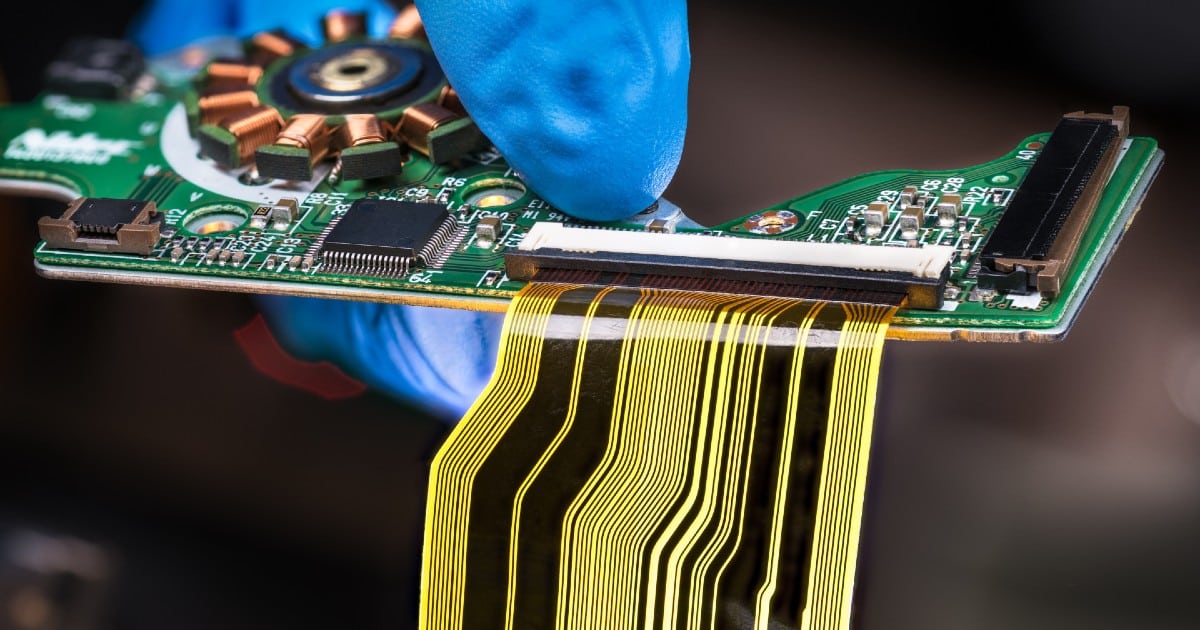
Flexible printed circuit (FPC) interconnects can be designed as custom components that can replace a much larger cable assembly or wiring harness.
The choice between FPCs versus custom cabling creates tradeoffs that directly impact system reliability, electromagnetic performance, and mission success in defense applications. Understanding these trade-offs is essential for engineers developing the next generation of military and aerospace electronic systems.
Mil-Aero Interconnect Design Challenges
Military and aerospace electronic systems operate in environments that would destroy most commercial electronics.
Temperature extremes ranging from -55°C in high-altitude reconnaissance missions to +125°C in engine bay applications create thermal cycling stresses that can cause solder joint failure and material degradation.
Humidity, salt spray, and chemical exposure in naval applications add corrosion challenges, while radiation exposure in space-based systems can degrade insulation materials and cause single-event upsets in sensitive circuits.
- Bend radius control: Minimum 6x cable thickness to prevent copper fatigue
- Vibration resistance: Must withstand 0.01-2 kHz per MIL-STD-810
- Current density: Limit to 1000 A/in² for flex circuits vs. 3000 A/in² for wire
- Impedance tolerance: ±10% maximum variation across temperature range
- Shielding effectiveness: >40 dB required for sensitive RF applications
| Environmental Parameter | Commercial Spec | Mil-Aero Requirement | Design Impact |
| Operating Temperature | 0°C to +70°C | -55°C to +125°C | Requires polyimide substrates |
| Shock Resistance | 10G | 100G+ | Reinforced connector interfaces |
| EMI Shielding | 20 dB typical | >40 dB required | Hatched ground planes needed |
Mechanical stresses present equally demanding challenges. Aircraft and missile systems must survive shock loads and continuous vibration across broad frequency spectrums as defined in MIL-STD-810.
These conditions can cause wire fatigue, connector loosening, and intermittent connections that are difficult to diagnose and potentially catastrophic in operation.
Supply chain security requirements further limit component choices, requiring ITAR-compliant fabrication vendors and component sources.
Enjoying this article?
Subscribe to Interference Technology for expert coverage of EMI, EMC, and signal integrity challenges—plus immediate access to new digital magazine issues.
Subscribe here →
EMI/EMC Design Comparison
EMC presents one of the most challenging aspects of interconnect design in military and aerospace systems, where standard commercial approaches often fall short of meeting stringent defense requirements.
The unique construction of flexible printed circuit cables requires careful consideration of hatched ground plane design to achieve adequate EMI shielding while maintaining mechanical flexibility.
- Hatch opening size: Often taken to be λ/4 to λ/20 at highest frequency of concern
- Pattern offset: Stagger openings between layers for improved shielding effectiveness
- Edge rate limitation: Sub-nanosecond signals may exceed hatched plane capabilities
| Interconnect Type | Shielding Effectiveness | Flexibility | Power Handling | Best Application |
| Off-the-shelf FPC | 20-30 dB | High (single axis) |
<2A per trace | Low power, digital |
| Custom hatched flex | 35-45 dB | Good (dynamic or static bend) |
<5A per trace | Moderate power, digital |
| Shielded wire harness | 50-70 dB | High (multi-axis) |
>20A per wire | High power, RF |
Mating connectors represent another critical EMI vulnerability point in flex cable systems.
Standard FPC connectors often lack sufficient ground pins to maintain consistent reference planes across the interface, creating impedance discontinuities that can radiate emissions or allow external interference to couple into the system.
- Ground pin interleaving: Place ground pins around digital pins in the pinout to ensure a reference return path
- Impedance matching: Input impedance through the connector should match the input trace impedance
- Shield termination: 360° shield termination preferred over pigtail connections
- Ferrite placement: Common mode chokes within 1” of connector interface
Custom flex PCB designs become necessary when standard solutions cannot achieve required hatch density or when specific impedance matching is needed for sensitive RF applications.
- Ferrite cores: Type 31 material for 1-300 MHz, Type 43 for 25-300 MHz
- Filter modules: Multi-stage higher order LC filters
- Common mode chokes: Impedance >1 kΩ for common-mode noise
- Shielding gasket: High shielding effectiveness for enclosure interfaces
Power distribution through flex interconnects presents additional challenges, as switching supplies can inject common mode noise that radiates from inadequately shielded connector interfaces.
Custom cable assemblies allow strategic placement of EMI suppression components that standard flex ribbons cannot accommodate.
Design Guidelines and Mission Framework for Mission-Critical Applications
Selecting the optimal interconnect solution for military and aerospace systems requires systematic evaluation of mission requirements against technical capabilities and risk factors.
The decision framework must prioritize reliability and performance over cost considerations, as field failures in defense applications carry consequences far beyond component replacement costs.
| Application Requirements | Standard Flex Ribbon | Hatched Ground Flex PCB | Wire Harness |
| High pin density (>100 pins) | Excellent | Excellent | Poor |
| Multi-axis routing flexibility |
Poor | Fair | Excellent |
| High power (>10A) | Poor | Fair | Excellent |
| Extreme temperature (-55°C to +125°C) |
Fair | Good | Excellent |
| Field maintenance capability | Poor | Poor | Excellent |
| EMI shielding (>50 dB) | Poor | Good | Excellent |
| Space constraints (<5mm height) |
Excellent | Good | Poor |
Risk Mitigation Strategies:
- Redundancy planning: Design dual-path interconnects for critical signal paths
- Qualification testing: Perform accelerated life testing beyond standard commercial requirements
- Supply chain management: Maintain approved vendor lists with multiple sources
- Design margin: Derate current and voltage specifications by 50% minimum
- Environmental protection: Specify conformal coatings and sealed connectors for harsh environments
Progress towards higher power density and data rates is driving use of newer flex materials, such as liquid crystal polymer substrates.
Interconnects on these materials can operate with higher bandwidth and thus support higher data rates compared to traditional polyimide due to their lower Dk value for the flex materials.
However, these components still cannot support the very high data rates found in some high-density connector and cable systems, where supported data rates reach into the 10’s of GHz.